Do not replace a sump-pump backup battery by matching voltage alone. Use the controller or pump manual to confirm battery chemistry, BCI group size, capacity range, terminal layout, quantity and enclosure/ventilation requirements. A “12-volt deep-cycle” label is only the beginning of the compatibility check.
Compatibility checklist
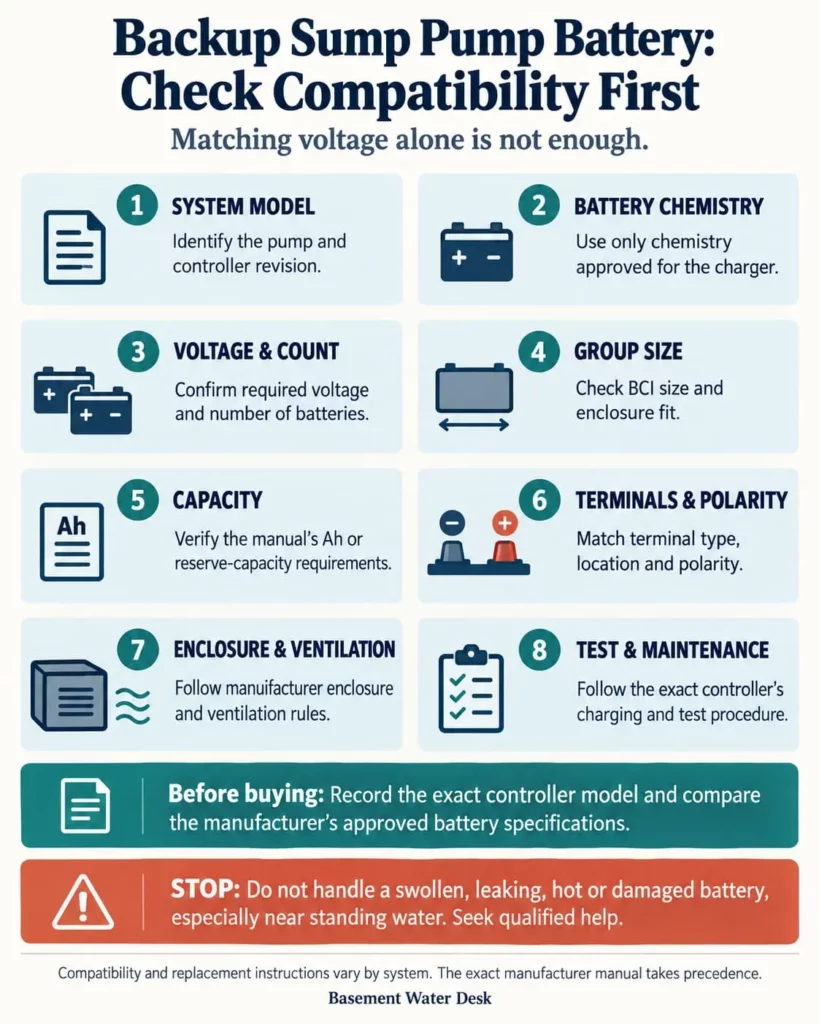
| Check | Where to find it | Do not assume |
|---|---|---|
| System model and controller revision | Controller label, pump label and owner’s manual | A battery approved for a newer controller is automatically approved for an older one. |
| Battery chemistry | Manual and manufacturer compatibility list | Flooded lead-acid, AGM and other chemistries are interchangeable with the same charger. |
| Voltage and battery count | Manual wiring diagram and battery compartment | Every backup uses one 12 V battery. |
| BCI group/physical size | Manual, existing battery label and enclosure measurements | A battery that fits the tray has correct terminals and capacity. |
| Amp-hour or reserve-capacity range | Manual and battery data sheet | A higher number always improves runtime without affecting charger performance or space. |
| Terminal type and polarity | Manual diagram and battery label | Cables can safely be stretched, crossed or adapted. |
| Ventilation and enclosure | Installation manual | A sealed-looking battery eliminates every ventilation requirement. |
| Controller reset/test procedure | Manual alarm table | Silencing an alarm proves the new battery is healthy. |
When replacement is reasonable
Replace based on the exact manual, controller test and observed condition—not a universal age rule. Some manufacturers publish a specific interval; others specify testing or replacement after a failed status check. For example, one current Zoeller manual calls for a Group 27 deep-cycle battery and a three-year replacement cycle for that system. That interval cannot be copied to a different controller.
Before anyone disconnects the old battery
- Record the system. Photograph the controller label, pump model, battery label, cable routing and alarm display from a dry location.
- Read the battery section of the exact manual. Confirm whether the manufacturer permits homeowner replacement and identify shutdown, polarity and ventilation requirements.
- Choose a dry work window. The backup will be unavailable while disconnected. Do not service it during active inflow or when the primary pump is unreliable.
- Plan safe handling and recycling. Lead-acid batteries are heavy and contain corrosive material. Arrange retailer take-back or household hazardous-waste collection before removal.
- Plan the post-install test. Follow the controller manual for charge time, status reset and functional testing. Do not simulate an outage by entering a wet pit or handling energized connections.
Alarm after a new battery
| Observation | Possible explanation | Next step |
|---|---|---|
| Low-battery indication immediately after installation | The battery may need the manual-specified initial charge time, or the connection/selection may be wrong. | Keep the primary system available; follow the exact manual before clearing alarms. |
| Alarm remains after the stated charge period | Incorrect battery, poor connection, failed charger/controller or defective battery is possible. | Contact the system manufacturer or qualified service provider. |
| Controller reports battery OK but pump test fails | Battery status alone does not verify pump, float, piping or real flow. | Stop relying on the backup until the full system is tested. |
| Corrosion returns quickly | Moisture, venting, charging or terminal issues may be present. | Have the installation and charger assessed; do not merely clean and ignore it. |
Dispose of the old battery correctly
EPA advises returning lead-acid batteries to a battery retailer or local household hazardous-waste program. Do not place one in household trash or curbside recycling. Protect terminals and transport it upright in a stable, acid-resistant container as directed by the recycler.
Sources and scope
Requirements vary by model and jurisdiction. Use the exact equipment manual and local authority when either is more specific than this guide.
- Liberty Pumps — Model 441 battery backup manual — Model-specific battery, charger, ventilation and safety requirements.
- Zoeller — Aquanot Spin installation instructions (FM3166) — Example of a manufacturer-specific Group 27 battery requirement and replacement interval.
- WAYNE — ESP25n battery backup manual — Model-specific battery and backup-system instructions.
- Basement Watchdog — Manuals and Videos — Current model manuals and battery documentation.
- US EPA — Used Household Batteries — Lead-acid batteries should go to a retailer or household hazardous-waste program, not household trash.