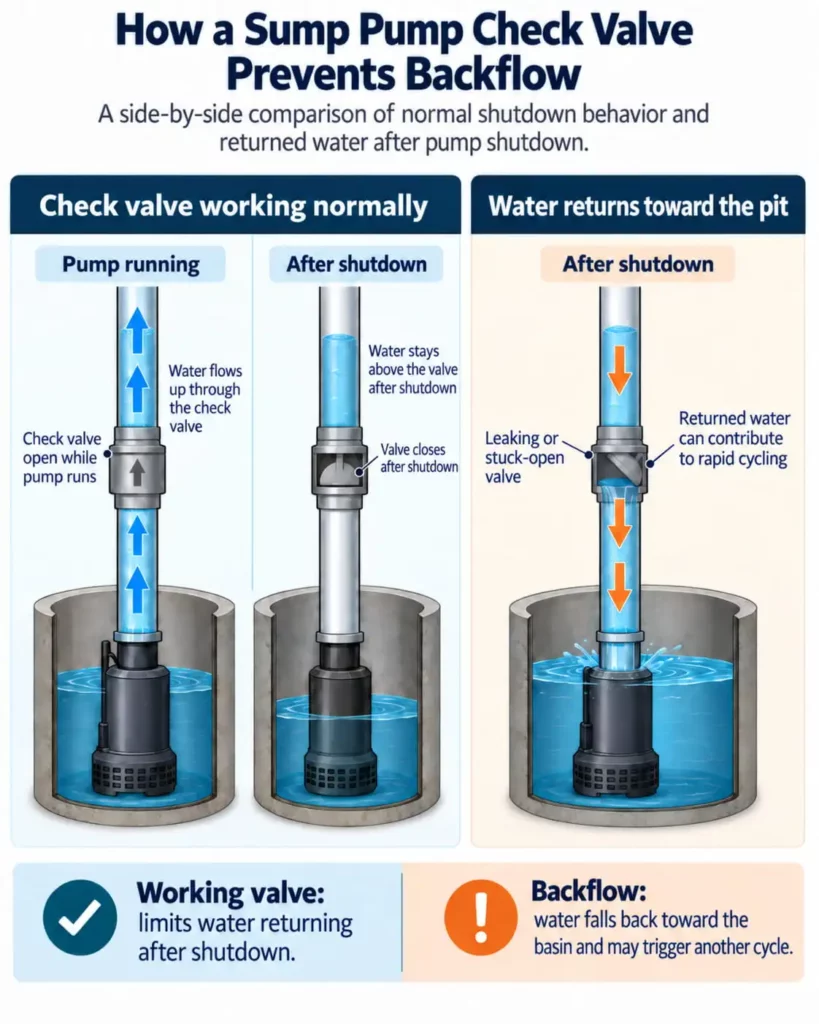
A sump-pump check valve is a one-way valve in the discharge line. It lets pumped water travel away from the pit and limits that water from falling back after shutdown. Backflow, rapid repeat cycles, a hard shutdown bang or a leaking valve joint can point toward the valve, but each symptom has other possible causes.
Last reviewed October 4, 2026.
Where the check valve fits in the system
Pit
Water enters the basin.
Pump
Moves water into the discharge pipe.
Check valve
Allows flow away from the pump and limits return flow.
Discharge
Carries water safely away from the foundation.
What to verify before choosing or placing a check valve
There is no single installation height, vent-hole size or valve position that should be copied from another sump system. Before replacing or relocating a check valve, check the instructions for the exact pump and valve.
| Detail to verify | Why it matters |
|---|---|
| Discharge pipe size | The valve and connections need to match the discharge arrangement specified for the system. |
| Flow direction | The valve must allow pumped water to travel away from the pit while limiting return flow after shutdown. |
| Allowed orientation | Confirm whether the exact valve may be installed vertically, horizontally or only in a specified position. |
| Position relative to the pump | The pump or valve manual may specify where the check valve should sit in the discharge line. |
| Anti-airlock or vent-hole requirement | Some pump instructions require a vent hole below the check valve, but the required size and location are model-specific. |
| Service connections | Check whether the installation instructions call for unions, couplings or another removable connection for servicing the pump or valve. |
Manufacturer instructions can differ even on details such as the anti-airlock hole. For example, one current Flotec manual specifies a 1/8-inch hole below the check valve, while Zoeller support recommends a 3/16-inch vent hole between the pump and check valve. Treat those as examples of model-specific guidance, not universal dimensions.
Common failure signs
| Observation | Possible valve relationship | Other possibilities | Next step |
|---|---|---|---|
| Water visibly returns after shutdown | Valve missing, stuck open, leaking or installed incorrectly | Water entering from drains; discharge routing problem | Observe the return surge and have valve orientation/condition checked. |
| Pump restarts soon after every stop | Returned discharge volume can cause short cycling | High inflow, small operating range, switch setup | Time the cycle and watch for immediate backflow. |
| Loud bang at shutdown | Valve closes abruptly; moving water column can transmit force | Loose/unsupported discharge pipe | Do not hold moving pipe; assess valve type and pipe support. |
| Leak at valve or coupling | Loose/damaged connection or valve body | Cracked pipe or installation/pressure issue | Stop if spraying near electricity; call a plumber. |
| Pump runs but little/no water leaves | Valve stuck closed or incorrectly installed is possible | Frozen/clogged line, blocked intake or pump fault | Use the no-flow guide. |
Standard versus “quiet” check valves
The word quiet usually describes a valve designed to close more gently and reduce the slam created by a moving water column. It does not fix loose pipe support, an incorrectly routed discharge, a valve that is the wrong size, or a pump that is short cycling for another reason. Match the valve to the pipe and pump instructions rather than choosing by noise claim alone.
What to collect before replacement
- Pump and valve manufacturer/model
- Nominal discharge pipe size and material
- Valve orientation and flow arrow
- Whether the problem is bang, leak, backflow, short cycling or no flow
- Whether pipe visibly moves at shutdown
- The pump manual’s check-valve and vent/anti-airlock requirements
Sources and scope
Use the manual for your exact pump, controller, valve and backup system when it differs from general guidance.
- Zoeller — Check Valves — Manufacturer check-valve product information.
- Zoeller — Owner’s Manual FM0937 — Example of model-specific installation requirements.
- Flotec / Pentair — Owner’s Manual 42158 — Example of model-specific check-valve placement and anti-airlock-hole requirements.
- Pentair — Sump Pump Troubleshooting FAQ — Manufacturer troubleshooting information for float, flow, noise, check valves and common failure modes.
- Zoeller — Product Support — Manufacturer support on vent-hole placement and other model-specific requirements.