Quick answer: Waterproofing basement walls from the inside can mean several different things. A coating may reduce minor surface dampness, a targeted repair may address a specific crack, and an interior drainage membrane can route water to a perimeter drain and sump. None of those is the same as stopping groundwater on the exterior side of the foundation, so the right approach depends on how the moisture is reaching the wall.
Last reviewed October 1, 2026.
Jump to: What “inside waterproofing” means · Identify the moisture path · Coatings · Crack repair · Interior drainage · Inside vs. outside · Quote checklist
What does “waterproofing basement walls from inside” actually mean?
The phrase is broad. An interior coating, crack repair and interior drainage system may all be sold as “waterproofing,” but they do different jobs.
| Interior approach | What it does | What it does not automatically solve |
|---|---|---|
| Paint, sealer or cementitious coating | Creates a surface layer that may reduce minor dampness or moisture transfer when the substrate and conditions are suitable | Does not remove groundwater pressure, fix drainage outside the wall or correct structural movement |
| Targeted crack or penetration repair | Addresses a specific, identified opening or leakage path | Does not correct broader perimeter or groundwater problems elsewhere |
| Interior wall drainage membrane | Provides a controlled path for water that reaches the inside face of the foundation wall | Does not stop water from reaching the exterior side of the foundation |
| Interior perimeter drain | Collects water at the wall-floor or sub-slab perimeter and routes it to a sump or another approved outlet | Does not replace exterior grading, gutters, downspouts or a suitable final discharge path |
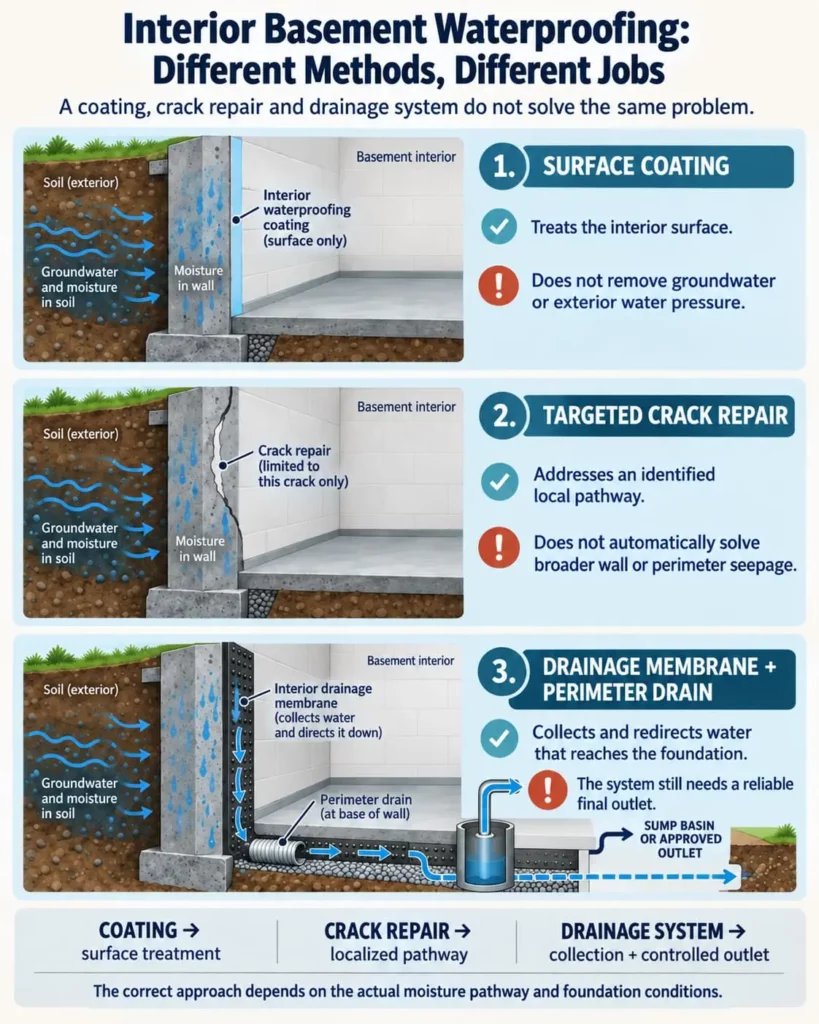
That distinction matters because the University of Minnesota Extension recommends controlling the moisture source first and notes that an interior membrane or coating without drainage generally does not solve a basement moisture problem in the long term. Building-science guidance also treats foundation waterproofing, drainage, grading and roof-water management as parts of one system rather than interchangeable fixes.
Identify the moisture path before choosing an interior fix
The most useful question is not “Which waterproofing product should I use?” It is “How is moisture reaching this wall?”
| What you observe | More consistent with | What to check before choosing a repair |
|---|---|---|
| Broad damp film on a cool wall during humid weather | Condensation may be contributing | Indoor humidity, weather and whether other cool surfaces are also damp |
| White powder, staining or peeling coating without obvious flowing water | Moisture moving through porous masonry or concrete may be involved | Rain timing, exterior drainage and whether the wall becomes wetter near the base |
| Water visibly follows one crack or pipe penetration | Localized liquid-water pathway | Whether the crack changes, whether movement is visible and whether other areas stay dry |
| Water repeatedly appears along the wall-floor joint after rain | Perimeter groundwater or drainage limitation may be plausible | Exterior runoff, sump behavior and whether several sections of the perimeter become wet |
| Hollow block wall is wet near the bottom courses | Water may be present within the wall system as well as on the visible surface | Wall construction, drainage path and whether the proposed system actually drains the wall |
| Crack is accompanied by bowing, displacement, heaving or other movement | Structural condition needs separate assessment | Do not treat the visible moisture as only a waterproofing problem |
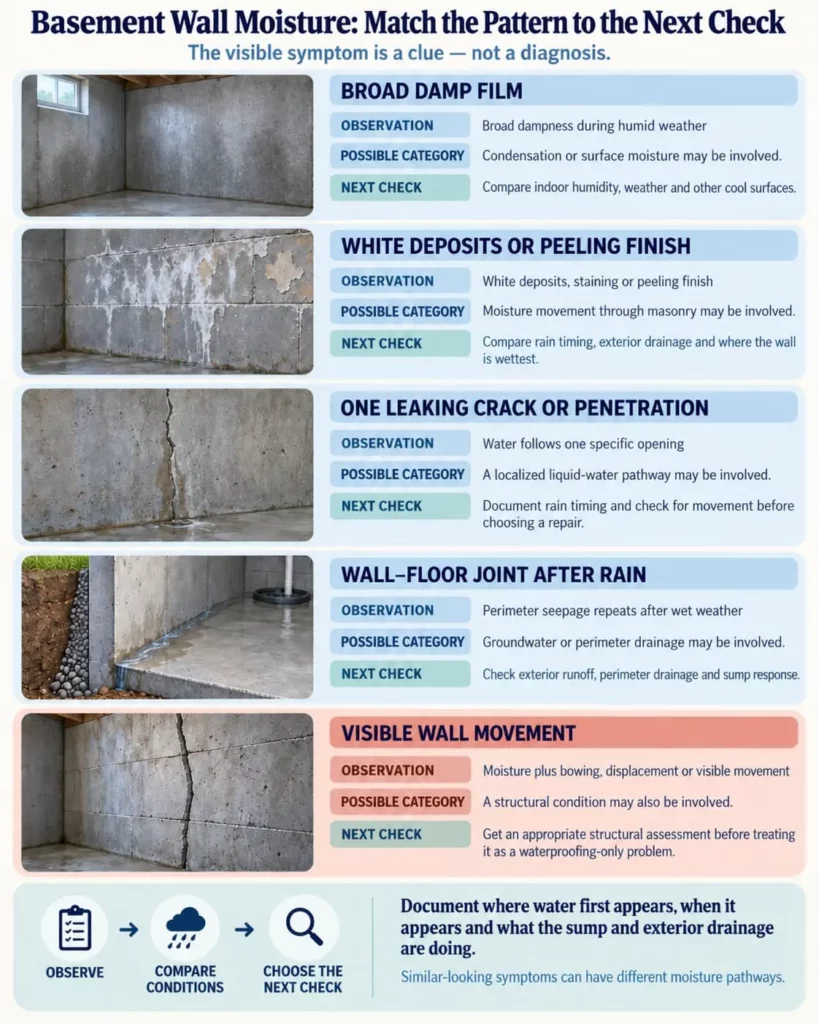
If you are not sure whether the water is coming from the wall, slab or wall-floor joint, start with the water seeping through basement floor guide. If the problem appears mainly after storms, use the broader heavy-rain guide to map the first visible entry point.
When an interior waterproof coating may help — and when it is the wrong tool
An interior coating can be useful only when the moisture condition and wall surface are compatible with that product. It should not be treated as a universal answer to active groundwater entry.
- Minor dampness is different from active leakage. A surface treatment has a different job from a drainage system that must manage liquid water.
- Surface preparation matters. Loose paint, efflorescence, dirt and deteriorated material can prevent a coating from bonding properly.
- Hydrostatic pressure does not disappear because the inside surface is coated. If water is accumulating against the foundation, drainage remains part of the diagnosis.
- Peeling or blistering can be evidence, not just a cosmetic defect. Recoating without understanding why the old finish failed can hide the symptom temporarily.
What about sealing a leaking basement wall crack from inside?
A single confirmed crack can be a much narrower problem than widespread wall or perimeter seepage. Targeted repair may therefore make sense when the crack is the actual water pathway and the surrounding wall remains dry.
But a wet crack does not prove that sealing the visible opening alone will solve the water-management problem. Exterior runoff, saturated soil and groundwater can continue loading the foundation and may find another path if the underlying drainage condition remains unchanged.
- Photograph the crack while it is leaking and when it is dry.
- Note whether leakage begins during intense rain, hours later or after several wet days.
- Check whether the wall-floor joint or nearby cracks become wet at the same time.
- Record whether the crack width or wall alignment appears to change.
- Do not treat bowing, displacement or progressive movement as a waterproofing-only issue.
Interior drainage is different: it manages water instead of pretending it never arrived
For an existing basement where exterior excavation is impractical, an interior drainage approach can be a legitimate water-management strategy. Building Science Corporation describes retrofit systems that combine a full-height interior drainage layer with an interior perimeter drain connected to a sump. The purpose is to give water that reaches the foundation a controlled route instead of allowing it to emerge unpredictably into the finished space.
1. Water reaches the foundation
Groundwater or saturated soil loads the below-grade wall.
2. Interior drainage layer receives it
A membrane or drainage space lets water move downward instead of entering the room.
3. Perimeter drain collects it
The wall drainage connects to a drain at the slab perimeter or below the slab.
4. Sump or approved outlet removes it
The collected water still needs a reliable destination and discharge path.
This is closely related to the systems described in the basement French drain guide. The key question is whether the proposal explains the complete water path from the wall to the final outlet.
Inside vs. outside basement waterproofing
Interior and exterior approaches work at different points in the water path.
| Question | Interior approach | Exterior approach |
|---|---|---|
| Where does it act? | On the inside surface or after water has reached the foundation assembly | On the soil side of the foundation before water reaches the interior surface |
| Can it avoid excavation? | Often, depending on the system | Usually no when the below-grade wall must be exposed |
| Can it relieve or manage collected water? | Yes, when connected to an interior drainage path and sump/outlet | Yes, when exterior drainage layers and footing drains carry water away |
| Does a coating alone replace drainage? | No | No; exterior waterproofing also depends on drainage and water management |
| Main scope question | Where does water go after it reaches the wall? | How is water kept from accumulating against the foundation? |
DOE Building Science Education and the Concrete Masonry & Hardscapes Association both describe below-grade waterproofing as part of a broader system that includes drainage, grading and management of roof water. That is why comparing only “inside versus outside” without discussing where the water goes is incomplete.
Concrete wall vs. concrete block wall
Foundation material changes the way water can move and the way an interior system must be designed. A poured concrete wall may present a localized crack or porous area, while hollow concrete masonry units can hold and move water through their cores.
University of Minnesota Extension specifically notes that a simple drainage channel attached above the slab does not fully solve water held within masonry block cores. Ask how the proposed system handles the actual wall construction rather than assuming one detail works for every basement.
Before finishing or covering the basement wall
Do not use framing, insulation, drywall or a decorative coating to make an unresolved moisture problem disappear from view. Moisture management should be addressed before the wall assembly is enclosed.
- Identify whether the wall is poured concrete, block or another system.
- Document rain timing and the first wet point.
- Correct obvious gutter, downspout and grading problems.
- Confirm whether water reaches the wall-floor joint or slab as well as the wall.
- Understand the drainage and final discharge path if water is being collected indoors.
- Keep sump and drainage service points accessible.
- Resolve visible structural movement before treating the wall as a moisture-only problem.
What an interior basement waterproofing quote should explain
The phrase “waterproof the basement walls from inside” is too vague for a useful proposal. The quote should identify the moisture pathway and the mechanism the work is intended to control.
| Quote item | What should be clear |
|---|---|
| Observed problem | Condensation, vapor/dampness, localized leakage, wall-floor seepage or another identified pathway |
| Wall construction | Poured concrete, block or other foundation type |
| Interior method | Coating, crack repair, drainage membrane, perimeter drain or a combination |
| Water pathway after the work | Whether water is blocked, collected or redirected and where it goes next |
| Sump or outlet | Whether a new or existing sump/outlet is part of the system |
| Exterior water management | Whether grading, gutters, downspouts or exterior drainage also need correction |
| Surface preparation | How coatings, repairs or membranes will be applied to the existing wall |
| Finishes and restoration | What happens to framing, drywall, flooring or stored contents |
| Maintenance access | How drains, sump equipment or service points can be inspected later |
| Warranty | What failure is covered, for how long and what exclusions apply |
If you are comparing contractor proposals after identifying the moisture pathway, use the basement waterproofing cost guide to compare method, drainage, sump, restoration and other scope differences before comparing totals.
The bottom line
Waterproofing from the inside is not one method. A coating, crack repair and interior drainage system solve different problems.
If the issue is condensation or indoor humidity, waterproofing may be the wrong starting point. If one stable crack is the confirmed path, a targeted repair may be more appropriate than a whole-perimeter system. If recurring groundwater reaches the wall-floor perimeter, an interior drainage system may manage the water effectively, but it still needs a complete collection and discharge path.
Choose the repair from the moisture pathway, not from the word “waterproofing” on the product or quote.
Sources and scope
This guide explains common moisture-control and drainage concepts for existing U.S. basements. Foundation construction, soil, groundwater, structural conditions and local requirements vary. It does not specify a universal waterproofing system for a particular home.
- University of Minnesota Extension — Moisture in basements: causes and solutions — Moisture sources, condensation, capillary and vapor movement, coatings and interior drainage approaches.
- U.S. Department of Energy Building Science Education — Concrete Foundation Walls: Damp-Proofed and Waterproofed — Exterior waterproofing, drainage planes and foundation drainage as a complete water-management system.
- Concrete Masonry & Hardscapes Association — Preventing Water Penetration in Below-Grade Concrete Masonry Walls — Waterproofing, dampproofing and drainage principles for below-grade masonry walls.
- Building Science Corporation — BSI-110: Keeping the Water Out of Basements — Site drainage, exterior water management and interior drainage retrofit concepts.