Quick answer: There is no single reliable “average basement waterproofing cost” because contractors may be pricing completely different jobs under the same label. A coating, one crack repair, an interior perimeter-drain system and full exterior excavation are different scopes. Use published cost guides only as planning context, then compare quotes by what water pathway they address, what work is included and where the collected water ultimately goes.
Last reviewed October 3, 2026.
Jump to: Published 2026 ranges · Why quotes vary · Cost by method · Interior vs. exterior · Quote checklist · Compare three quotes
What published 2026 basement waterproofing cost guides actually say
Current national cost guides disagree substantially. That is useful information by itself: “basement waterproofing” is not a standardized project.
| 2026 source | Published figure | Important scope note |
|---|---|---|
| Angi | $2,461–$8,202 | Professional basement waterproofing range; method, location, foundation and related repairs change the total. |
| Fixr | $3,000–$10,000 | Common national range across different waterproofing approaches. |
| Modernize | $1,500–$7,000 | Average project range; method and severity are major variables. |
| HomeGuide | $6,000–$12,000 interior; $10,000–$18,000 exterior | Separates interior and exterior systems rather than giving one number for both. |
| This Old House | $12,447–$14,833 for a 1,000-sq.-ft. basement | Uses a size-based estimate and separately lists lower interior and higher exterior method ranges. |
These figures are not directly interchangeable. They come from different publishers, methodologies and project definitions. They are shown here to demonstrate the spread in published 2026 planning numbers—not to calculate a new “true average.”
Why basement waterproofing quotes vary so much
Several variables can change the scope before labor or material pricing is even considered.
| Cost driver | Why it changes the quote | What to ask |
|---|---|---|
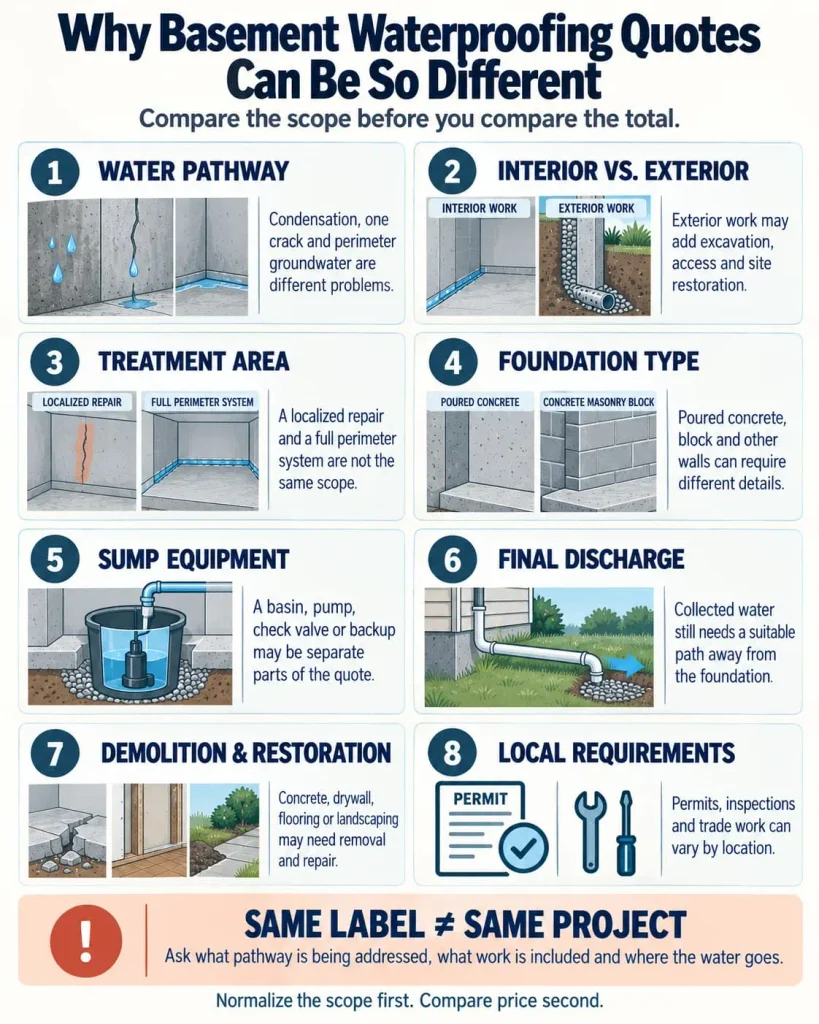
| Moisture pathway | Condensation, one crack, wall seepage and perimeter groundwater need different responses. | What observation supports the proposed method? |
| Interior vs. exterior access | Exterior work may require excavation, utility clearance, backfill and landscape restoration. | Exactly how much excavation and restoration are included? |
| Length of perimeter treated | A short localized drain and a full-perimeter system are not comparable scopes. | How many linear feet are included? |
| Foundation construction | Poured concrete, block and other wall systems can require different drainage and repair details. | How does the proposed system handle this wall type? |
| Sump equipment | A new basin, primary pump, check valve, discharge or backup can add separate work. | Which components are included by model or specification? |
| Final discharge | Moving collected water safely away from the foundation may require additional piping or site work. | Where will the system discharge, and is that included? |
| Finished basement | Removing and restoring drywall, flooring, framing or trim adds labor and materials. | Who removes and restores finishes? |
| Electrical or plumbing work | Dedicated circuits, pump connections or plumbing changes may be separate trades. | Are these included or excluded? |
| Permits and local requirements | Requirements vary by jurisdiction and project type. | Who obtains permits and pays fees if required? |
| Warranty scope | A long warranty is not useful if it excludes the actual failure mode. | What specific condition is covered and excluded? |
Cost by method: make sure the method matches the problem
The same homeowner can receive several very different “waterproofing” proposals because each contractor is pricing a different intervention.
Surface coating or sealer
This is a smaller scope than excavation or perimeter drainage, but price alone does not make it appropriate. An interior coating cannot remove groundwater pressure or replace a drainage path. If the wall is broadly damp, first distinguish condensation or moisture movement through masonry from active liquid-water entry.
Use the interior basement wall waterproofing guide to compare what coatings, targeted crack repair and interior drainage actually do.
Localized crack or penetration repair
A confirmed local pathway can justify a much narrower project than whole-basement drainage. The scope should explain whether the repair is intended to stop one opening or whether the contractor believes the crack is evidence of a broader water or structural condition.
Interior perimeter drainage
An interior perimeter drain collects water at or below the slab edge and routes it to a sump basin or another approved outlet. The price therefore depends on perimeter length, concrete removal and replacement, wall drainage detail, sump equipment, discharge routing and finished-basement restoration.
Before comparing prices, use the basement French drain guide to confirm what the contractor means by the proposed drainage system.
Exterior excavation and waterproofing
Exterior work can include excavation to the footing, wall preparation, crack or defect repair, a waterproof layer, drainage protection, footing-drain work, backfill and restoration of landscaping, patios or other surfaces. Because access and restoration vary dramatically, a national average is especially weak as a predictor for one house.
Interior vs. exterior waterproofing cost: do not compare unlike scopes
Published 2026 guides generally place exterior waterproofing above interior work because excavation and restoration add major labor and site work. But “interior” can range from a coating to a full perimeter drain and sump system, so even that comparison is incomplete without the scope.
| Question | Interior proposal | Exterior proposal |
|---|---|---|
| Where does the work happen? | Inside the basement at the wall, slab edge or sump area | Outside the foundation, often down to the footing |
| What often drives labor? | Concrete removal, perimeter length, sump/discharge and finish restoration | Excavation depth, access, utilities, membrane/drainage work, backfill and site restoration |
| What must the quote explain? | Where collected water enters the system and where it is discharged | How exterior water is intercepted, drained and kept away from the wall |
| Can the lower price be misleading? | Yes, if a narrow treatment is being compared with a complete drainage system | Yes, if excavation scope, drain work or restoration is excluded |
Do you need waterproofing—or a cheaper water-management correction first?
Before paying for a basement waterproofing system, document obvious exterior conditions. Gutters that overflow, short or disconnected downspouts, ponding beside the foundation and soil sloping toward the house can all increase the amount of water reaching the foundation.
If the problem is strongly linked to storms, start with the water after heavy rain guide. If water first appears through the slab or wall-floor joint, use the floor seepage guide before assuming the wall itself needs waterproofing.
What a basement waterproofing quote should include
- Observed water pathway: where the contractor believes water enters and what evidence supports that conclusion.
- Exact treatment area: specific walls, cracks or number of linear feet—not just “basement waterproofing.”
- Method: coating, injection, drainage membrane, perimeter drain, exterior excavation or a defined combination.
- Drain destination: sump basin, gravity outlet or another permitted discharge path.
- Sump scope: whether basin, primary pump, check valve, backup and electrical work are included.
- Discharge scope: pipe route, exterior termination and any freeze or drainage considerations.
- Demolition and restoration: concrete, drywall, flooring, framing, trim and landscaping.
- Permits and inspections: who is responsible if required locally.
- Maintenance: what needs inspection or service after installation.
- Warranty: exactly what condition triggers coverage and what exclusions apply.
How to compare three waterproofing quotes without being misled by the total
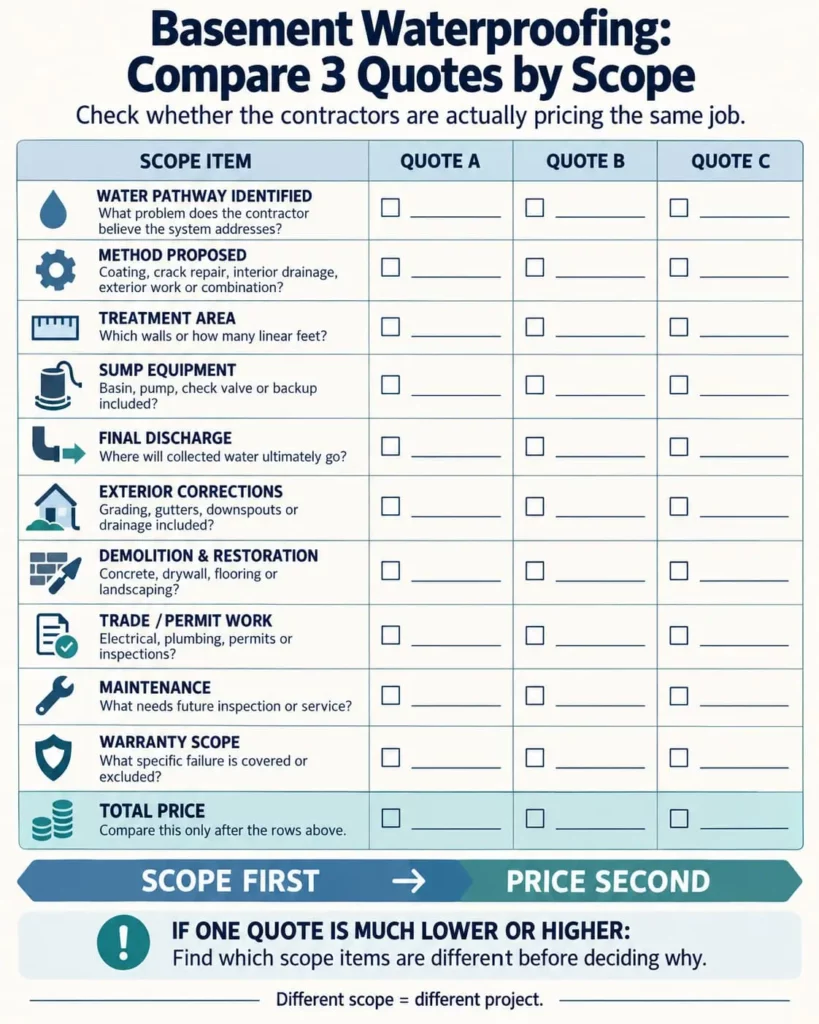
Normalize the scope first. Put the proposals side by side and compare each line item before comparing the final price.
| Compare | Contractor A | Contractor B | Contractor C |
|---|---|---|---|
| Water pathway identified | — | — | — |
| Method proposed | — | — | — |
| Linear feet / treatment area | — | — | — |
| Sump equipment included | — | — | — |
| Discharge included | — | — | — |
| Exterior corrections included | — | — | — |
| Demolition / restoration | — | — | — |
| Permit / electrical / plumbing | — | — | — |
| Maintenance requirements | — | — | — |
| Warranty scope | — | — | — |
| Total price | — | — | — |
If one quote is thousands of dollars lower, identify which rows are missing before assuming it is better value. If one is much higher, ask what additional failure mode or scope it is addressing.
The bottom line
Basement waterproofing cost is a poor decision metric until the scope is defined. Published 2026 guides span widely because they group together projects that are not technically equivalent.
First identify the water pathway. Then compare methods. Then normalize the scope of the quotes. Only after that should you compare the final price.
Sources and scope
Cost figures on this page are planning references from current U.S. national cost guides, not quotes for a specific property. Different publishers use different datasets, scopes and definitions. Local labor, excavation access, foundation type, drainage design and restoration can materially change a project total.
- Angi — How Much Does Basement Waterproofing Cost? [2026 Data]
- Fixr — How Much Does It Cost to Waterproof a Basement? [2026 Data]
- Modernize — How Much Does Basement Waterproofing Cost?
- HomeGuide — How Much Does Basement Waterproofing Cost?
- This Old House — How Much Does Basement Waterproofing Cost? (2026 Pricing)