Start with the behavior, not the part. A sump pump that is silent, humming with no flow, running continuously, cycling every few minutes or making a new noise needs a different path. If water may contact electrical equipment, stop before testing anything.
Last reviewed September 24, 2026.
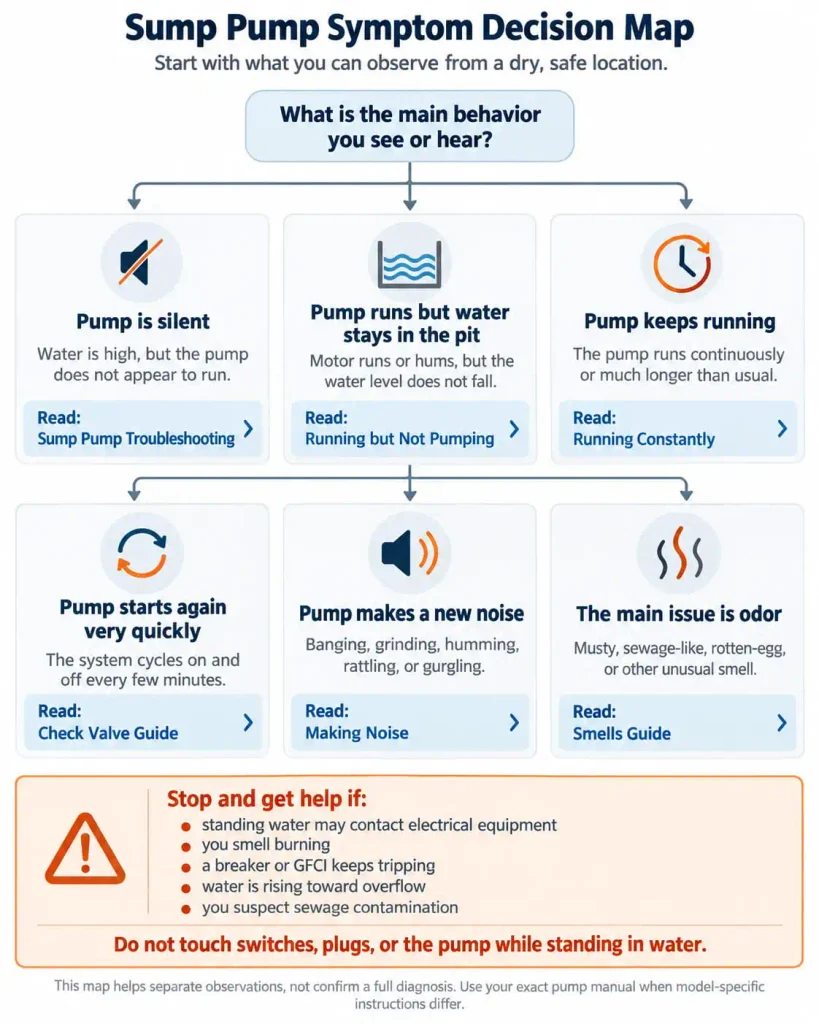
60-second symptom map
| What you observe | Most useful distinction | Safe observation from a dry area | Best next page |
|---|---|---|---|
| Pump is silent while water is high | Power/control/float problem versus pump failure | Note whether the house has power, whether an alarm/controller is lit and whether the float is visibly obstructed. Do not reach into the pit. | Stay on this page; use the exact model manual before any model-specific test. |
| Motor hums or runs but the pit level does not fall | The pump is energized but useful flow is missing | Look for outdoor discharge and note whether water immediately returns after shutdown. | Running but not pumping |
| Pump never shuts off | Real inflow versus stuck control versus backflow | Watch pit level, incoming water and discharge pattern. | Running constantly |
| Starts again within seconds or minutes | Short cycling or returned discharge water | Time several cycles and watch for a return surge after shutdown. | Check-valve symptoms |
| New bang, hum, grind, rattle or gurgle | Sound timing matters more than loudness alone | Record whether the sound occurs at start, during the run, at shutdown or after shutdown. | Noise guide |
| Odor is the main problem | Musty/stagnant water versus sewage/gas/chemical/burning | Identify the odor category without prolonged exposure or adding cleaners. | Odor guide |
Know the parts you’re looking at
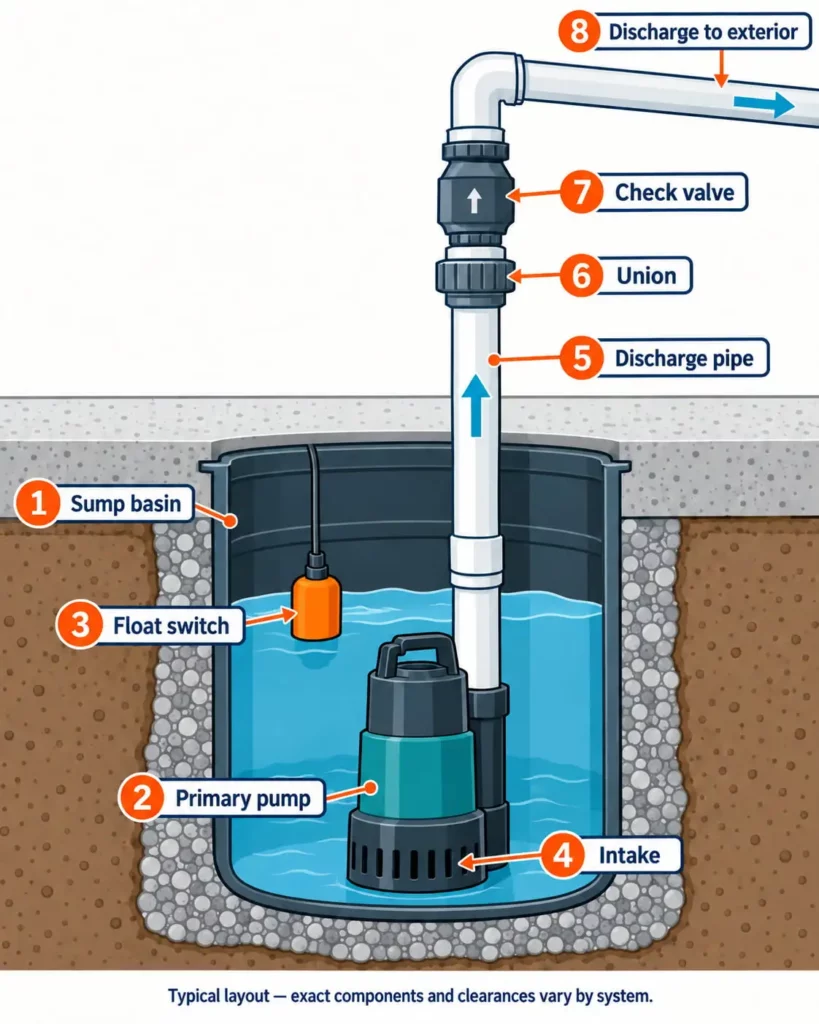
If the pump will not turn on
The most useful first question is whether the problem is really a pump failure. Loss of utility power, a tripped protective device, a controller/alarm issue, a float that cannot move and an internal pump fault can all present as “nothing happens.” Manufacturer troubleshooting procedures differ by switch and model. Only use a model-specific test when the area and equipment are dry and the manufacturer says that test applies.
- Record the exact pump and controller model. Photograph the data plate from a dry, safe position if possible.
- Note the water level. A rising pit changes this from diagnosis to flood prevention.
- Look for a visibly trapped float. Do not reach into an energized or wet pit.
- Check the manual. Some manufacturers describe switch tests, piggyback-plug tests or alarm codes; do not assume another model uses the same procedure.
What not to conclude
A full pit does not prove the pump motor failed. A running motor does not prove water is moving. Frequent operation after a storm can be real groundwater load, while frequent operation in otherwise dry conditions points toward a different problem. Treat each as an observation until the water path, control and discharge behavior are separated.
What to record before you call
- Pump and controller manufacturer/model
- Whether the motor is silent, humming or audibly running
- Whether the pit level rises, falls or stays unchanged
- Whether water is visibly discharging outdoors
- Whether water falls back immediately after shutdown
- Recent rain, snowmelt, outage or freezing weather
- Any alarm lights, beeps, breaker/GFCI trips, leaks or unusual odor
Sources and scope
Use the manual for your exact pump, controller, valve and backup system when it differs from general guidance.
- CDC — Reentering Your Flooded Home — Electrical and reentry safety around standing water.
- Pentair — Sump Pump Troubleshooting FAQ — Manufacturer troubleshooting information for float, flow, noise, check valves and common failure modes.
- Zoeller — Product Support — Manufacturer manuals and model-specific support.
- Liberty Pumps — Installation Manuals — Model-specific manuals for primary and backup systems.
Plan for a failure, not only a symptom
If outages are part of the risk, compare backup system types. If a backup already has an aging battery, use the compatibility checklist before buying a replacement.